

Trolleite Meaning and Properties

Trolleite History
The gemstone trolleite was first found in the late 1860s and officially described in 1868. It was named by Blomstrand in honor of Hans Gabriel Trolle-Wachtmeister, a Swedish attorney general and chemist.
Initially, trolleite was believed to be exclusive to Sweden's Vastana mine, making it exceptionally rare. However, other sources of the stone were later discovered, increasing its availability in the market, though it remains relatively uncommon.
Due to its recent discovery, trolleite lacks significant historical uses. It is mainly considered a collector's stone, although it is occasionally used for ornamental purposes.
What are the Metaphysical Properties of Trolleite?
Generally, trolleite is considered a calming stone, and some believe it can aid in conditions related to stress, pain, or anxiety. Trolleite meaning has been associated with promoting a sense of calm, which may lead to beliefs that it could be helpful for conditions like hypertension and anxiety.
Trolleite is often associated with a high vibration, believed to enable connections with guiding energies. It is frequently linked with the scorzalite mineral, enhancing its connection to dreams and insight. Many people consider trolleite an excellent stone for meditation, allowing access to inner wisdom and mental clarity in challenging or emotional situations. It is also believed to dissolve spiritual barriers, providing a calming energy to facilitate the process.
Moreover, some believe that trolleite assists in manifestation and enlightenment, making it easier to pursue goals and navigate life's journey. It is said to draw energy from past experiences, including past lives, leading to more informed choices in the present. Furthermore, trolleite meaning is linked to empowering individuals to identify life obstacles and take necessary actions for personal growth.
What is Trolleite Made From?
Initially, trolleite seemed to be predominantly found in Sweden, making it a scarce gemstone. However, over time, other deposits were discovered in various countries, expanding the availability of the stone to some extent. Presently, Australia, Brazil, Rwanda and the United States are all known sources of trolleite.
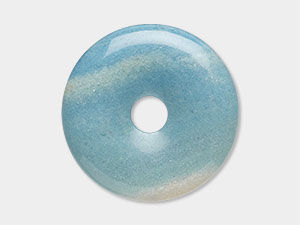
Among these, the Minas Gerais region of Brazil stands out as one of the most significant sources. Trolleite inclusions, often in sizable amounts, are frequently found within quartz masses in this area. As a result, trolleite has become reasonably accessible in the marketplace today. In addition to being sought after by collectors, the stone is cut, polished and shaped, enabling it to find its way into jewelry designs.
Trolleite is an aluminum phosphate mineral that combines quartz, lazulite and scorzalite. It usually forms in large masses, and its transparency varies from translucent to transparent, depending on the crystal's composition and the presence of inclusions.
In terms of luster, trolleite is commonly described as having a greasy appearance, with a subdued shine even when polished.
The stone's color is influenced by the presence of dark blue minerals like lazulite. The hardness of trolleite varies depending on its specific composition. While the bulk of the stone falls within the 5-1/2 to 6 range on the Mohs hardness scale, the quartz portions are typically closer to 8-1/2. This variation can determine whether a particular piece of trolleite is suitable for everyday wear or more suitable for low-contact jewelry pieces.
- Mineral Information: Aluminum phosphate mineral that combines quartz, lazulite, and scorzalite
- Chemical Composition: Al4(PO4)3(OH)3
- Color: Light green, colorless, bluish green, (dark blue when included)
- Hardness: 5-1/2 to 6 (Mohs)
- Specific Gravity: 3.10
- Refractive Index: 1.619 – 1.643
How Do You Clean Trolleite?
Trolleites are generally tough stones, but the best cleaning method is to simply use warm, soapy water and a soft brush. It is not recommended to use harsh chemicals when cleaning trolleite. Be sure to thoroughly dry trolleite jewelry after cleaning to ensure there is no residual moisture that could cause adverse reactions, such as rust in metal settings. Store trolleite jewelry inside a soft cloth or, at least away from other stones to avoid the risk of scratching this gemstone against a harder stone or scratching a less hard stone.
Trolleite FAQs
Q: Where is trolleite primarily sourced from?
A: Trolleite is found in Sweden, Brazil, Rwanda, Australia and the United States.
Q: Why do trolleite beads vary so much in appearance?
A: Trolleite is a mix of several different minerals. Its appearance varies depending on the proportions of its various components.
Q: Why is trolleite sometimes mistaken for other blue gemstones?
A: Trolleite resembles other blue gemstones, such as lapis lazuli, with its mottled surface colors and varied blue hues.
Designing with Trolleite
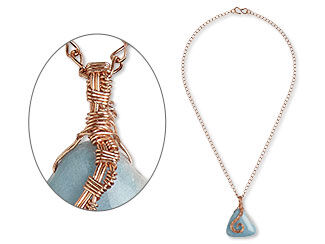
The gentle blues of trolleite look beautiful when paired with both gold- and silver-hued metals. Accent with other blue gemstones such as angelite, lapis lazuli or amazonite, or set off the beautiful blue hues with white gemstones or pearls.
A Design Inspiration to Get You Started
Shop for Trolleite
**Please note that all metaphysical or healing properties listed are collected from various sources. This information is offered as a service and not meant to treat medical conditions. Fire Mountain Gems and Beads® does not guarantee the validity of any of these statements.
How did you like this resource? Your feedback helps us provide resources that matter to you most.
All works of authorship (articles, videos, tutorials and other creative works) are from the Fire Mountain Gems and Beads® Collection, and permission to copy is granted for non-commercial educational purposes only. All other reproduction requires written permission. For more information, please email copyrightpermission@firemtn.com.