

Slate Meaning and Properties
Slate History
Slate is a common material that has been used for centuries for a variety of applications and is still used frequently today. It is most known for its use in roofing materials. However, slate is also commonly used for chalkboards, billiard tables, flooring, gravestones and landscaping.
Slate is frequently chosen over other materials because of its durable, but malleable, composition. It is also very aesthetically pleasing. The use of slate as roofing material has a history in the United States dating back to pre-revolutionary times. Slate roofs were often recommended and encouraged to fireproof construction of homes and buildings; however, this was not the first use of slate globally. Slate was a frequently used material during the Second Empire and during the Gothic Revival, High Victorian Gothic and Tudor styles.
Slate has currently seen a rise in demand and popularity due to historic preservation and the newfound realization of its superiority over other materials.
What are the Metaphysical Properties of Slate?
Slate is believed by many to be a balancing stone. Slate gemstone meaning is associated with balance because it is a symbol of harmony among the elements (earth, air, fire and water). As a balancing stone, it is thought to settle anxiety and balance the chakras, resulting in total inner harmony. When in balance, the chakras are said to be more open to receiving and giving positive energies, allowing them to function at optimal capacity. Slate gemstone meaning is also associated with memory and the passage of time.
What is Slate Made From?
A foliated metamorphic rock of fine-grained clay or volcanic ash, slate is composed of muscovite or illite as well as quartz. Slate is often incorrectly confused with shale, as slate is a derivative of shale sedimentary rocks. Slate derives from shale due to low-grade metamorphism. The shale-type sedimentary rock undergoes low pressures and temperatures of 200-320 degrees Celsius, resulting in the production of slate. While it flakes relatively easily, it is a durable stone frequently selected to make tiles. Slate is most commonly gray in color, ranging from light to dark shades. However, slate can be found in a variety of colors including green, red, black, purple and brown, often from the same extraction site. The color composition is largely dependent on the variation of minerals present during metamorphism.
Spain is the largest producer of slate, with Brazil coming in second. While these locations produce the majority of natural slate, it can be found all over the world with some special variations. For example, Maine is known for a dark purple shade of slate.
- Chemical Composition: Slate is mainly composed of clay minerals or micas as well as quartz and a small amount of feldspar, calcite, pyrite, hematite and other minerals.
- Color: Light to dark gray, as well as green, red, black, purple and brown. The color of slate is determined by the amount and type of iron and organic material that are present in the rock.
- Hardness: 5-1/2 (Mohs)
- Specific Gravity: 2.65 – 2.80
How Do You Clean Slate?
Refrain from using vinegar or lemon juice as a cleaning agent, as either could potentially etch the surface. To clean the stone, stick to mild detergents or stone cleaners with a neutral pH level. Then, rinse with water and dry with a soft cloth.
Slate FAQs
Q: What are the natural colors of slate?
A: Slate is usually a variety of grey, but it also occurs in shades of green, red, black, purple and brown.
Q: Can you drill slate?
A: With the proper tools and procedures, slate can be drilled.
Q: Where is slate sourced?
A: Slate is found all over the world.
Designing with Slate
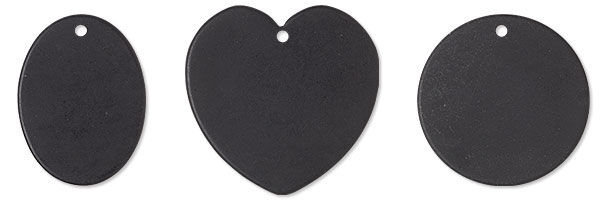
Slate can be used to incorporate fun and lighthearted elements in jewelry designs. This stone is frequently used in chalkboards, making it a great interactive addition to jewelry. With slate pendants or focals, personal messages or drawings can be added and replaced.
**Please note that all metaphysical or healing properties listed are collected from various sources. This information is offered as a service and not meant to treat medical conditions. Fire Mountain Gems and Beads® does not guarantee the validity of any of these statements.
How did you like this resource? Your feedback helps us provide resources that matter to you most.
Copyright Permissions
All works of authorship (articles, videos, tutorials and other creative works) are from the Fire Mountain Gems and Beads® Collection, and permission to copy is granted for non-commercial educational purposes only. All other reproduction requires written permission. For more information, please email copyrightpermission@firemtn.com.