

Zircon Meaning and Properties

Zircon History
With an Australian specimen dating back approximately 4 billion years, zircon is one of the oldest minerals on Earth. The name zircon most likely derives from the Persian word, "zargun" meaning gold colored. Zircon gemstones were a popular choice for jewelry in the Victorian era when they were used as a popular diamond substitute. They are found in heirloom jewelry dating from the 1880s. It is a birthstone for December, along with turquoise and tanzanite. Zircon is said to make up the leaves of the sacred wish-fulfilling Kalpavriksha tree in the Hindu religion.
What are the Metaphysical Properties of Zircon?
Zircon is associated with all the chakras. It is used by crystal healers to alleviate physical and mental ailments. Beneficial properties include reducing fevers, soothing pains, relieving stomach cramps, asthma, lung problems and menstrual pains. Zircon is believed to stimulate the liver and is helpful for people detoxing from nicotine, alcohol and other substances. It is said to balance the adrenal glands when stressed or overtaxed at work. In the metaphysical world, it is valued as a cure for both nightmares and insomnia as it promotes restful sleep.
Mentally, zircon meaning is linked to dealing with loss and grief, as well as boosting passion for life and work. Zircon is used to aid in meditation and developing psychic intuition. It is said to clear negative energy and have a protective aura. Zircon meaning is also tied to wisdom, success, honor and wealth. Zircon is credited with helping one become more organized.
Specific colors of zircon are said to have unique properties:
- Blue zircon is said to help build relationships and self-confidence
- Colorless is thought to be good for mental purification and meditation
- Pink zircon is said to attract romance, new love and harmony
What is Zircon Made From?
Zircon is a transparent to semi-transparent silicate. Its crystal structure is tetragonal, a short, stocky four-sided prism with a pyramid end. It can contain uranium and have a slight fluorescence. The minimal radioactivity is said to pose no health hazards. Zircon is found as small crystals in metamorphic and igneous rocks, and as alluvial grains in sedimentary rocks.
Zircon comes in many colors and is a gem loved for its high refractive index, which gives it intense brilliance. Zircon has a rare optical quality called birefringence, or double refraction. When light passes through zircon, its rays split in two directions. This gives a high refractive index, a brilliant sheen and fire characterized by flashes of multi-colored light. Its luster is vitreous.
Zircon stones can have trace amounts of uranium and thorium. These elements cause a process which breaks down the internal crystal structures. Zircon is classified into high, medium or low categories depending on its optical properties. High zircons with prominent crystal structures and little or no damage from radiation are utilized in gemstone jewelry. Medium zircons have some radiation-induced damage. Low zircons have substantial crystal damage and in extreme cases are amorphous, meaning the crystal structure is practically gone. This produces a rare green "low" zircon that is sought after by collectors. Although the crystalline structure is gone, it still exhibits the fire.
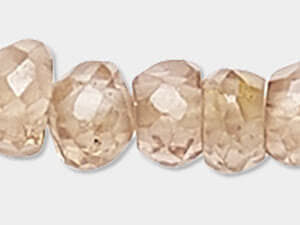
Gray-brown and red zircons are the most common, although they can also be found in yellow, orange, violet, blue and green. The colors are a result of impurities during the formation of the stone. Most zircons are heat treated to stabilize and bring out the vibrant colors. To get the most popular colorless and blue color, naturally colored zircon is heated to temperatures of 1472-1852°F. Trade names include "Starlight" for blue zircons, "Hyacinth" for yellow and yellow-red varieties and "Jargon" for the straw-colored stones. "Mataura diamond" is the name for the colorless heat-treated specimens used as brilliant diamond substitutes. Rose and rose-orange stones from Tanzania and the orange-brown from Cambodia are not enhanced.
Zircon is found around the world on all continents. Most is mined in Australia and Asia. In the United States, zircon is mined in Georgia, Virginia, North Carolina and Florida.
- Mineral Information: Zirconium Silicate
- Chemical Composition: ZrSiO4
- Color: Colorless, yellow, brown, orange, red, violet, blue and green
- Hardness: 6-1/2 to 7-1/2 (Mohs)
- Specific Gravity: 3.93 - 4.74
- Refractive Index: 1.180 - 2.024
How Do You Clean Zircon?
Zircon is hard enough to be fashioned into gemstones for use in rings, pendants, brooches and other jewelry. Exposure to ultraviolet rays in tanning beds and at nail salons can change the color from blue to brown. Also avoid prolonged exposure to sun. Zircon is a brittle material; when storing, it is advised to wrap jewelry a soft cloth so it does not encounter materials that could chip the gems.
Zircon FAQs
Q: How does zircon differ from cubic zirconia or other colorless gemstones?
A: While both zircon and cubic zirconia are used as diamond substitutes, there are huge differences. Zircon is a naturally occurring gemstone, whereas cubic zirconia is manmade. Their chemical formulas are different, and cubic zirconia is harder with a Mohs hardness of 8. Because it is lab-created, cubic zirconia is nearly always flawless, with excellent clarity. Zircon can be transparent to translucent, with occasional cloudiness that reduces its value.
Other clear gemstones include quartz crystal, goshenite and chalcedony.
Q: What colors are naturally found in zircon beads?
A: Zircon naturally occurs in clear, yellow, brown, orange, red, violet, blue and green—nearly a full rainbow spectrum.
Q: Where is zircon primarily sourced?
A: Zircon can be found worldwide, but most is mined in Australia and Asia.
Designing with Zircon
With their brilliant colors and luster, faceted zircon is enhanced in both gold and sterling silver settings. They are wonderful for people who want the sparkle of a diamond for a more economical price. Zircon gems are stunning in pavé jewelry components. They are often set with other semi-precious stones, such as emeralds, when mounted in ring or pendant settings. Zircon beads look incredible in necklace and earring designs combined with other gemstones in clusters, or on their own. Undrilled mini chips are ideal for inlay work.
Shop for Zircon
**Please note that all metaphysical or healing properties listed are collected from various sources. This information is offered as a service and not meant to treat medical conditions. Fire Mountain Gems and Beads® does not guarantee the validity of any of these statements.
How did you like this resource? Your feedback helps us provide resources that matter to you most.
All works of authorship (articles, videos, tutorials and other creative works) are from the Fire Mountain Gems and Beads® Collection, and permission to copy is granted for non-commercial educational purposes only. All other reproduction requires written permission. For more information, please email copyrightpermission@firemtn.com.