

Obsidian, Snowflake Meaning and Properties

Snowflake Obsidian History
Obsidian is a naturally occurring volcanic glass formed in swiftly cooling lava that has a high silica content. It is not considered a true mineral, as it does not have an entirely consistent chemical content and it does not form crystals. Obsidian gets its English name from a mistranslation of Natural History by Pliny the Elder (the guy who died of the eruption of Vesuvius that buried the ancient city of Pompeii).
"Among the various kinds of glass, we may also reckon Obsian glass, a substance very similar to the stone which Obsius [mistranslated as Obsidius] discovered in Æthiopia. This stone is of a very dark color, and sometimes transparent ... Many persons use it for jewelery, and I myself have seen solid statues in this material of the late Emperor Augustus .... Xenocrates says that Obsian stone is found in India also, and in Samnium in Italy; and that it is a natural product of Spain, upon the coasts which border on the Ocean."
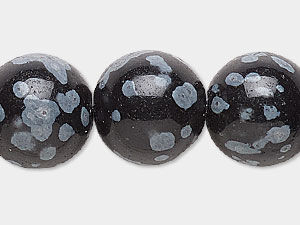
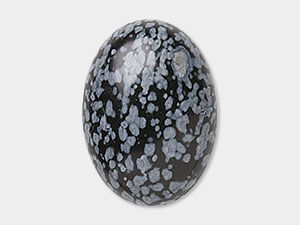
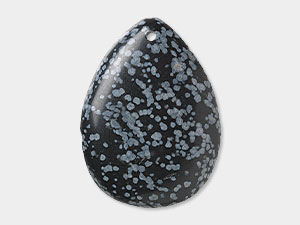
Color in obsidian varies, depending on impurities in the parent lava formation. Snowflake obsidian (also called "flowering obsidian") gets its name and patterns from cristobalite (a type of quartz) inclusions formed in the obsidian as it devitrifies.
The chemical make-up of obsidian also varies among volcanic sources--sometimes even different eruptions of the same volcano have different chemical types. This makes historical obsidian jewelry, tools or weapons a valuable resource to archaeologists for tracking trade routes or dating graves and settlements, as their source volcano and eruption can often be determined through analysis.
What are the Metaphysical Properties of Snowflake Obsidian?
Practitioners believe snowflake obsidian lets them see the dark and uncomfortable sides of their own natures, bringing them back into wholeness. A patterned stone, it is thought to help wearers see patterns in their own thoughts and behaviors. Snowflake obsidian meaning is associated with dissolving shocks, fears and traumas, both physical and emotional. Like a sky full of beautiful snowflakes, snowflake obsidian is said to restore something: a deep, abiding sense of protection and reverence.
Snowflake obsidian meaning is affiliated with the base and crown chakras. It is thought to drive out demons and to embody both yin and yang principles. Although not a birthstone, it is affiliated with the zodiac sign Capricorn.
What is Snowflake Obsidian Made From?
This naturally occurring volcanic glass is formed when felsic lava extruded from a volcano cools without crystal growth. This glass form later transmutes into a rock, with sunburst-shaped spherulite inclusions forming in the stone.
Snowflake obsidian is found all over the world including deposits in Italy, Scotland, the United States and other locations around the world with historic volcanic eruptions.
- Mineral Information: Volcanic, amorphous, siliceous glass
- Chemical Composition: SiO2 (approximately 70%) with a range of other trace elements
- Color: Black with white inclusions
- Hardness: 5 to 5-1/2 (Mohs)
- Specific Gravity: 2.3 to 2.6
- Refractive Index: 1.48 – 1.51
How Do You Clean Snowflake Obsidian?
This durable stone is easy to care for: just wash gently in warm, soapy water. Avoid using ultrasonic or steam cleaners. Soap residue can build up on it, so rinse well and polish after. If the piece has sharp edges, do this slowly and carefully, as obsidian edges can cut skin painlessly. Take care to store snowflake obsidian in a soft case away from hard objects, since the mid-range Mohs hardness means it can be easily scratched. Remove obsidian jewelry before engaging in physical activity.
Snowflake Obsidian FAQs
Q: Do all snowflake obsidian gemstone beads have inclusions?
A: Inclusions of cristobalite create the striking snowflake patterns in snowflake obsidian.
Q: Is snowflake obsidian really considered a volcanic glass?
A: Snowflake obsidian is a kind of volcanic glass. You can learn more about obsidian in the video from the article about black obsidian.
Q: Where is snowflake obsidian found?
A: Snowflake obsidian is found all over the world, wherever there is volcanic activity, including the United States, Italy and Scotland.
Designing with Snowflake Obsidian
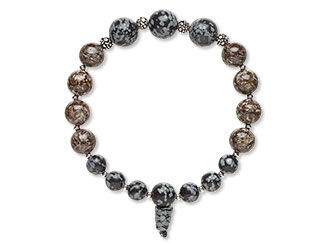
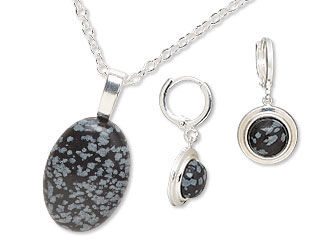
While snowflake obsidian is a striking gemstone, it is also a durable one—making it popular for use as a "worry stone" as well as in jewelry-making. For unusually beautiful jewelry with sophisticated flair, combine snowflake obsidian beads with black matte Delica and rock crystal beads (or any other pairings of black and white). Snowflake obsidian is a popular and attractive stone for men's jewelry and unisex styles, with the bold neutrals given added punch with red jasper, rhodochrosite and red or pink coral.
A Few Design Inspirations to Get You Started

Shop for Snowflake Obsidian
**Please note that all metaphysical or healing properties listed are collected from various sources. This information is offered as a service and not meant to treat medical conditions. Fire Mountain Gems and Beads® does not guarantee the validity of any of these statements.
How did you like this resource? Your feedback helps us provide resources that matter to you most.
Copyright Permissions
All works of authorship (articles, videos, tutorials and other creative works) are from the Fire Mountain Gems and Beads® Collection, and permission to copy is granted for non-commercial educational purposes only. All other reproduction requires written permission. For more information, please email copyrightpermission@firemtn.com.