

Repurposing Craft Supplies into Jewelry-Making Components

Whether you tried a new art form, inherited someone’s craftroom, bought an auction lot just for those vintage beads nobody makes anymore… what to do with all those supplies from other hobbies?
Make jewelry, of course.
Repurposing craft supplies from other hobbies into your jewelry-making is not physically hard. It just means you start from the point of view that everything is a jewelry component.
Yes, everything.
Here are some ideas to get you started.
The Random Stuff You Have
Besides jewelry-making, the four most popular crafting hobbies for adults involve:
- Yarn and String
Knitting, crochet, macramé, embroidery, cross-stitch, string art, latch hooking (hand-tufting / yarn knotting) - Clay
Pottery, sculpture, home décor, game pieces, mosaic tiles (tesserae), holiday gift items - Paper
Calligraphy, decoupagé, flower / leaf pressing, scrapbooking, cardmaking, stamping, paper quilling - Other 2D Crafting Supplies
Shrinkable plastic, painting, diamond painting, mosaic, bead mosaic
Yarn and String to Jewelry
Everyone knows somebody with a yarn stash.
Stringing materials of all types can be easily used in jewelry-making. Designers simply have to pair the right material with the right use. Yarn, along with embroidery floss and other string, is just one more stringing material jewelry makers can use for intentional effect:
- Yarn contains so many opportunities. Besides stringing directly onto yarn, one of the popular techniques for yarn is making tassel and pom-pom jewelry. Beyond the vast color palette available in yarn, knitters often accumulate a wide selection of fiber types (acrylic, wool, bamboo, mohair, multi-fiber blends, etc.) and styles (plied, eyelash, bouclé, chenille, etc.). Each fiber type, yarn style, color option and yarn weight can make your design lines more formal or mark them as straight outta boho. The style statement made by a sleek tassel of polished bamboo yarn will be very different than the style statement made by a fluffy pom-pom of hand-spun, hand-plied mohair yarn.
- Then there’s macramé and kumihimo. These two techniques alone can incorporate a diverse set of yarns, threads, flosses and strings. Jewelry makers can create elegant minimalist kumihimo bracelets using silk thread or cotton embroidery floss, or free-spirited micro-macramé bib necklaces incorporating bouclé yarns in lush earthtones.
- And, of course, don’t forget the friendship bracelet. This nostalgic go-to trend is traditionally made by knotting cotton embroidery floss. These days, it’s made a comeback, and is all grown up about it, too. The friendship bracelet has moved beyond the standard flat band; it now adds beads, charms, three-dimensional and sculptural shapes, plus lots more.
Finally, don’t miss out on décor! The maximalist décor trend wants more, more, more: more color, more surface embellishment, more layers of texture, sparkle and shine. There’s so much you could make, especially for the big gift-giving times of the shopping year. Kumihimo a pull for a ceiling fan. Use string art to create a room divider. Cross-stitch accent pearls onto a wall hanging.
Just think what you could make if you knit one, pearl two.


Clay to Jewelry
Pottery clays make fantastic jewelry components.
Polymer clays, metal clays and air dry resins are just the tip of the iceberg for moulding compounds. There’s also the fabulous beads, pendants, drops and décor components creative designers can make out of earthenware, stoneware, porcelain… Even fire clay, the stuff used to make bricks, is fantastic for jewelry-making pieces!
Like different metal clays, pottery clays have different uses, needs and requirements:
- Earthenware is often called terracotta (yes, like flower pots) and has that distinctive reddish, orangey-brown color. It doesn’t have to be fired in a kiln, just thoroughly dried. Dried (but not fired) terracotta pieces can be coated with clear or colorful resins to be water-resistant—though they’ll still be more fragile than if they were fired.
- Stoneware is the clay type that ceramic plates and bowls are made of. Trying to cover this type of unfired clay (greenware) with a jewelry-making resin will just create a thin shell of resin that doesn’t stabilize the item. It’ll crack like ice over a puddle on a March afternoon. It has to be kiln-fired to be useful as jewelry or home décor components—in a proper pottery kiln, at the proper temperature. Once fired, stoneware makes sturdy components that last and last.
- Porcelain is the other clay type commonly used for dishware, but it’s the high-end material. It requires special care during drying and absolutely must be kiln-fired. Thin-walled, fully fired porcelain pieces have a translucency that other pottery clays can’t attain, so components made of porcelain can be used for earring drops or décor items that let light pass through.
- Fire clay is the tough stuff. It’s also a kiln-fired pottery clay, fired at the highest temperature of these four types. Once fired, it resists heat and impact better than the others. It tends to have iron compounds in it, so is often red or speckled, depending on the clay source. Local differences in glacier clay deposits across the American Midwest mean that fire clays can be silver-grey, salmon pink, creamy-white, buff yellow and other colors.
Of course, there are assumptions made about pottery clays, but they are great for more than dishes and sculptures. Use them to create game pieces, multiple sizes of tesserae (mosaic tiles), custom displays for your jewelry lines, core elements for windchimes and suncatchers, and lots more. And, of course, if any pieces break—no worries! Wirewrapping, mosaic, resin setting are just some ways to use the pieces.
Consider making a porcelain pendant and also the box the customer stores it in (after you’ve added a gorgeous chain or custom cord). Talk about a one-of-a-kind customer experience!


Paper to Jewelry
The paper arts have been turning into jewelry components since Victorian women turned wallpaper scraps into jewelry.
So many art forms use paper and each can be recycled, upcycled or created exclusively for jewelry product lines. Papermaking gives a jewelry maker 100% control of where they begin, down to the composition of the paper their art is appearing on. Going for a nature-inspired product line? Be sure to add flowers and leaves to the paper before layering on other paper art techniques:
- First off, that gloriously popular paper art: origami. Not just earrings sporting tiny paper cranes, but dozens of other folded shapes using gorgeous Washi paper—or onionskin pages from a damaged Bible. Don’t throw it in the trash, or burn it! Fold origami cups centering on Psalm 23:5 and offer customers a faith-based jewelry line to show their cups runneth over.
- Calligraphy is the art of beautiful writing and requires only the pen and the ink. There are hundreds of calligraphy fonts (called “hands”), and each conveys its own meaning and style. There are formal hands, casual hands, hands so decorative that they look more like an ink drawing than a word, and more! From discreet monograms to florid medieval-style capitals, calligraphy can turn words directly into jewelry components. A coating of a sealant such as Mod Podge® turns handwriting into handmade fashion. And when the pen nibs wear out, turn those into pendants or drops, too!
- Speaking of Mod Podge®, decoupagé is popular art form using paper. Even Picasso created with it! In the 1960s and 1970s, decoupagé was a huge home décor trend. Folk artists covered vases, desk organizers, wall art, furniture and other home accessories with layers of paper and varnish. But this paper art has moved beyond serving trays: micro-decoupagé now appears over shapes in cardstock, acrylic, lightweight wood, shell and other materials. What to do with that stack of mid-1990s National Geographic® magazines…. How about jewelry sets featuring gorgeous butterfly pictures, or images of different species of mushrooms? Or layering a suitcase charm over a decoupagéd map for your next summer jewelry line?
- Paper quilling is another paper art that uses decoupagé-adjacent techniques, tools and supplies. Paper quilling is the art of rolling, coiling and shaping narrow strips of paper to create a design, that’s usually mounted on a rigid backing material. Similar in look to string art, quilling is much, much older: nuns were trimming the gilded edges off damaged book pages and using the paper to embellish altarpieces. Remember the soutache bead embroidery trend: stitching beads between coiled shapes in cord to make necklace centerpieces and earring drops? It borrowed a lot of ideas from paper quilling. Once you seal the backing material, you can protect that jewelry line from moisture.
- And finally, the same techniques, tools and supplies used for paper quilling are utilized to create rolled paper beads. Those pretty end papers on that old hardcover novel? Those beads will be gorgeous! (Be sure to seal them, so they won’t absorb perspiration.)
Anything that can be added to the surface of paper to embellish it—drawing, stamping, dry transfer, gilding, embossing, etc.—can be used to add to the look and feel of your jewelry design lines. Of course, other jewelry-making supplies can be added to the paper after it’s shaped: flat backs, glass micro beads, metallic foils and colorants like paint, glitter, Gilders Paste® or mica powder.
You have so many more options than the Victorians.


Other 2D Crafting Supplies to Jewelry
What other crafts and crafting supplies could you end up with? Everything but the kitchen sink, probably:
- Painting—watercolor, acrylic or the oil painting made popular by Bob Ross—is one of the oldest artistic expressions of humanity. The cave paintings of Lascaux show just how long people have been adding color to surfaces.
- Mosaic making turns small pieces (called tessera, plural tesserae) of glass, gemstone and metal into patterns. Ancient Roman dining room floors often had a mosaic design on them, and it’s a popular art for modern day creators. Modern mosaic makers often repurpose broken pottery and glass, parts of seashells, pieces of mirrors, buttons, bottle tops and more. Most mosaic art ends up being sized better for décor, but individual tesserae can be striking centerpieces for bib necklace centers, oversized brooches, purse flaps and other fashion accessories.
- Micro-mosaics have been created in Italy been since the late 1700s. Signet rings and watch fobs were the styles back then; in the 1970s, micro-mosaics started turning up on brooches, plus beads, pendants, clasps and other jewelry-making components. Undrilled micro-beads, inlay chips, intact or broken beads,
- Bead mosaics are an incredibly popular art form, spearheaded by Sabrina Frey’s fabulous kits. This art form is a relative of micro-mosaics, turning colorful glass beads into décor. The tools and techniques can easily be scaled down to create jewelry components, especially when placed in bezel settings and mountings.
- Diamond painting is a fantastic, colorful and easy new art form closely related to mosaic work. Most are packaged as kits and the tiny square tiles (called diamond drills) are usually added to a pre-glued canvas that’s included in the kit. Every kit includes extra diamond drills, so a dedicated diamond painter is going to end up with quite a collection! They can be set in a range of adhesives, including Apoxie Sculpt, in bezel settings—like any other mosaic form.
- Shrinkable plastic, often referred to by the brand name Shrinky Dinks®, can show up in craft rooms around the world. Considered a “kid-safe” art, shrinkable plastic sheets come in a range of opacities, colors and surface finishes. Some can be printed on with a laser printer; others have surfaces that look like soap bubbles or antiqued metals. Anything that can be printed or drawn can be turned into jewelry components (just punch the holes before shrinking). Be sure to make a test piece to check what the shrink rate is for any batch of sheets.

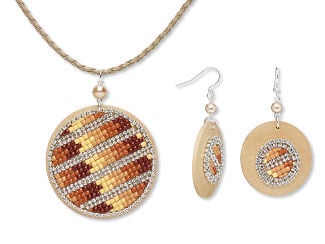

Whether it’s a palette of oil paints, a yarn stash, drawers of scrapbooking supplies or who knows what… you can repurpose it. Shift your perspective to see everything not as supplies from other art forms, but as components you can turn into truly one-of-a-kind jewelry and décor.
Shop for Your Materials Here:
Have a question regarding this project? Email Customer Service.
All works of authorship (articles, videos, tutorials and other creative works) are from the Fire Mountain Gems and Beads® Collection, and permission to copy is granted for non-commercial educational purposes only. All other reproduction requires written permission. For more information, please email copyrightpermission@firemtn.com.
**Please note that all metaphysical or healing properties listed are collected from various sources. This information is offered as a service and not meant to treat medical conditions. Fire Mountain Gems and Beads® does not guarantee the validity of any of these statements.